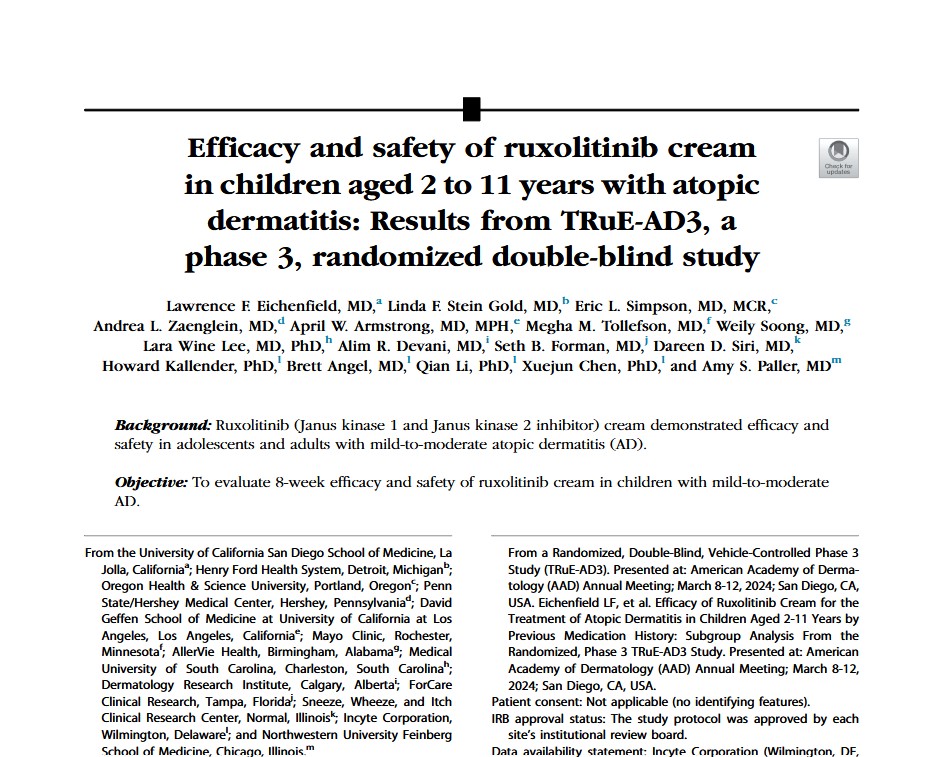
Read the original published study here.
Atopic dermatitis (commonly known as eczema) is a chronic, inflammatory skin condition that affects roughly 10% of children worldwide. It causes intense itching and skin pain, which can significantly lower the quality of life for both the children living with it and their caregivers.
Finding effective, steroid-free treatment options for mild-to-moderate eczema in young children can be challenging. Some traditional non-steroidal creams can be limited by modest efficacy or can cause uncomfortable stinging or burning when applied to irritated skin.
To address this need, researchers including our SWIA center here in Normal, IL conducted a major Phase 3 clinical trial called the TRUE-AD3 study. This study looked closely at how well a non-steroidal cream called ruxolitinib cream works, and how safe it is for young children.
What is Ruxolitinib Cream?
Ruxolitinib cream is a topical treatment that targets specific proteins in the skin called Janus kinase 1 (JAK1) and Janus kinase 2 (JAK2). These JAK proteins play a key role in triggering the inflammation, itching, and skin barrier breakdown associated with eczema. By blocking these signals locally, the cream helps calm the overactive immune response directly where it is applied. While it was already proven to be effective and safe for adults and teens , this trial tested its impact specifically on younger pediatric patients.
How the Study Was Done
The TRUE-AD3 study took place across 50 sites in the United States and Canada. It enrolled 330 children between the ages of 2 and 11 who had mild-to-moderate eczema covering between 3% and 20% of their bodies.
The children were randomly assigned to apply one of three treatments twice a day for 8 weeks:
-
0.75% ruxolitinib cream
-
1.5% ruxolitinib cream
-
A vehicle cream (a placebo cream that contains no active medication)
What Were the Results?
The study evaluated skin clearance, speed of itch relief, and improvements in the patients’ daily lives. The key findings included:
-
Clearer Skin: Children using ruxolitinib cream experienced significantly better skin clearance than those using the placebo cream. By the end of the 8 weeks, 36.6% of children using the 0.75% cream and 56.5% of children using the 1.5% cream achieved clear or almost clear skin, compared to just 10.8% of those using the placebo.
-
Rapid Improvement: Noticeable improvements in the severity and area of eczema were seen as early as week 2 (the very first assessment) and continued to improve through week 8. Efficacy responses were consistently highest with the 1.5% strength.
-
Faster Itch Relief: For children old enough to reliably self-assess their itch (ages 6 to 11), ruxolitinib cream brought relief much quicker. The median time to achieve meaningful itch relief was 11 days for the 0.75% cream and 13 days for the 1.5% cream, compared to 23 days for the placebo cream.
-
Better Sleep and Quality of Life: Because itch is a major cause of sleep loss in children with eczema, calming the skin led to substantial improvements in sleep quality and overall daily life for the children.
Is It Safe for Young Children?
The trial showed that ruxolitinib cream was well-tolerated by children as young as 2 years old.
-
Mild Side Effects: The vast majority of side effects were mild or moderate and resolved without children needing to stop using the cream. The most common side effects were minor upper respiratory tract infections (like the common cold) and nasopharyngitis (runny nose/stuffy throat).
-
Low Application Site Irritation: Even though more than 60% of the children in the study had eczema on their delicate face or neck areas, stinging or pain where the cream was applied was very rare.
-
No Systemic Concerns: Blood tests confirmed that the active medicine remained at very low, safe levels in the bloodstream. There were no signs of internal side effects that are sometimes associated with oral JAK inhibitors, such as blood cell count changes or serious internal infections.
The Takeaway
The TRUE-AD3 study provides strong evidence that ruxolitinib cream is a highly effective, fast-acting, and safe steroid-free option for children aged 2 to 11 with mild-to-moderate atopic dermatitis. It directly addresses a major unmet need for families looking for reliable, long-term eczema control without the use of topical corticosteroids.
Want to dive deeper into the medical data? You can view the full published scientific paper from the Journal of the American Academy of Dermatology (JAAD) here: Read the Full Publication.
Our Research Center’s Participation
We Advance Medicine, Together: Our dedicated clinical research center (SWIA) was proud to participate as one of the active investigational sites for TRUE-AD3 clinical trial. We are deeply committed to advancing pediatric dermatology and bringing innovative, non-steroidal therapeutic choices to families in our community.
Clinical trials are vital to discovering the next generation of safe, effective treatments. We invite you to explore our currently enrolling clinical trials or sign up for our research interest form today to receive updates on and be evaluated for ongoing and future pediatric and adult skin studies.