Allergy Diagnosis by Skin Prick testing
Allergy Diagnosis by Skin Prick Testing
Does Skin Testing Predict How Allergic You Are?
MIDWEST ALLERGY SINUS ASTHMA (MASA)
Sneeze Wheeze & Itch Associates | MASA Food Allergy Center for Treatment
Author: Dareen Siri MD
Step 1: Initial Skin Prick Testing
After conversing with us about your symptoms of food allergy, your suspicions, and your history of reactions, MASA clinicians will move on to diagnosing your food allergy.
Step 1 in the diagnosis of food allergy is skin prick testing. Skin prick testing for foods can be a robust predictor for the presence of a food allergy. However, once we assess that you do have a food allergy, the severity of the reaction may be quite variable from person to person. The triggering amount also may vary. Thus the intensity of the skin or blood tests cannot tell us how a person might react or what quantity the person will react to. This information is only achieved through a food challenge.
Example of Peanut Skin Prick Testing
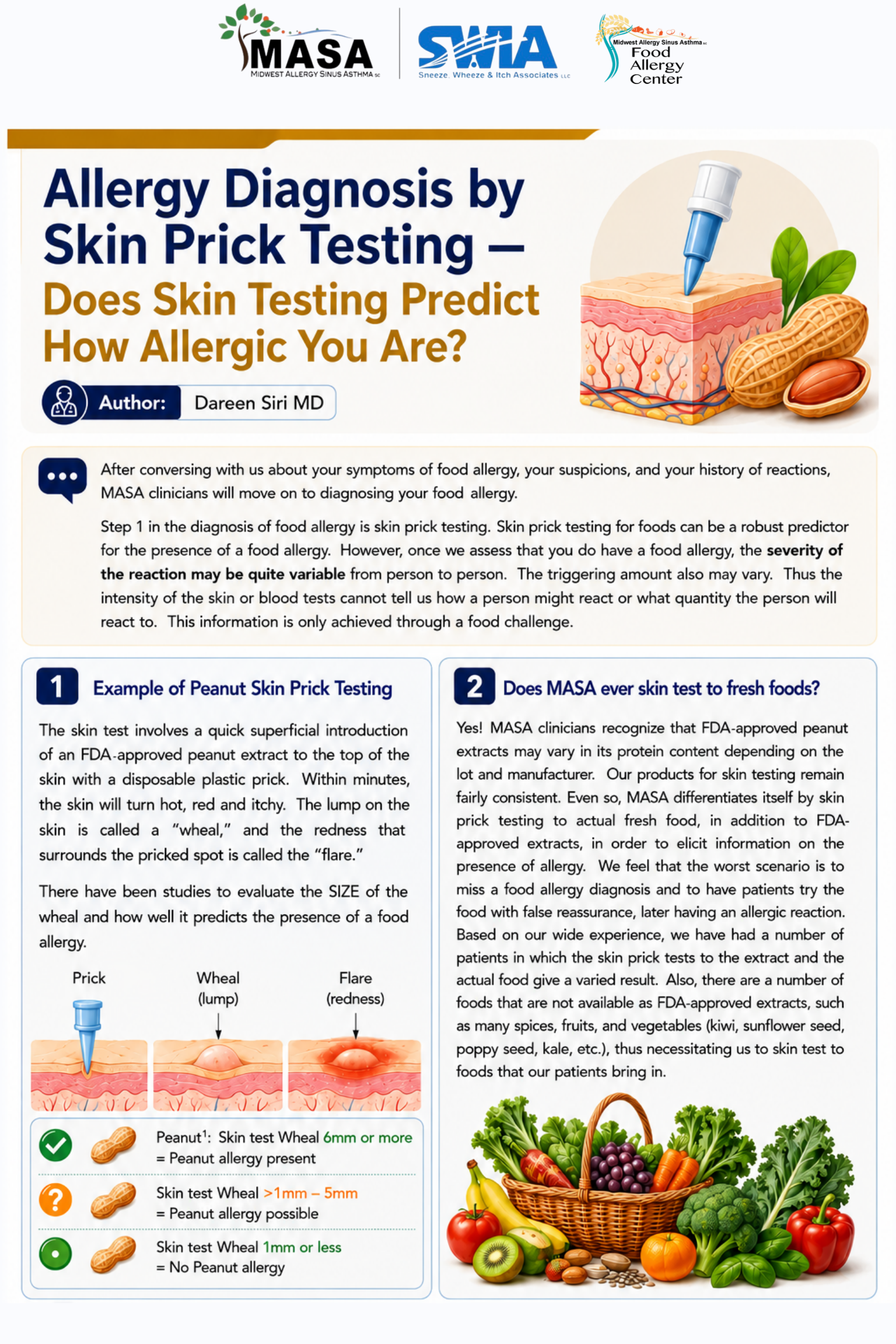
The skin test involves a quick superficial introduction of an FDA-approved peanut extract to the top of the skin with a disposable plastic prick. Within minutes, the skin will turn hot, red, and itchy.
- Wheal: The lump on the skin.
- Flare: The redness that surrounds the pricked spot.
There have been studies to evaluate the SIZE of the wheal and how well it predicts the presence of a food allergy:
- Skin test Wheal 6mm or more: Peanut allergy present
- Skin test Wheal >1mm–5mm: Peanut allergy possible
- Skin test Wheal 1mm or less: No Peanut allergy
Step 2: Skin Testing to Fresh Foods
Does MASA ever skin test to fresh foods?
Yes! MASA clinicians recognize that FDA-approved peanut extracts may vary in its protein content depending on the lot and manufacturer. Our products for skin testing remain fairly consistent. Even so, MASA differentiates itself by skin prick testing to actual fresh food, in addition to FDA-approved extracts, in order to elicit information on the presence of allergy. We feel that the worst scenario is to miss a food allergy diagnosis and to have patients try the food with false reassurance, later having an allergic reaction.
Based on our wide experience, we have had a number of patients in which the skin prick tests to the extract and the actual food give a varied result. Also, there are a number of foods that are not available as FDA-approved extracts, such as many spices, fruits, and vegetables (kiwi, sunflower seed, poppy seed, kale, etc.), thus necessitating us to skin test to foods that our patients bring in.