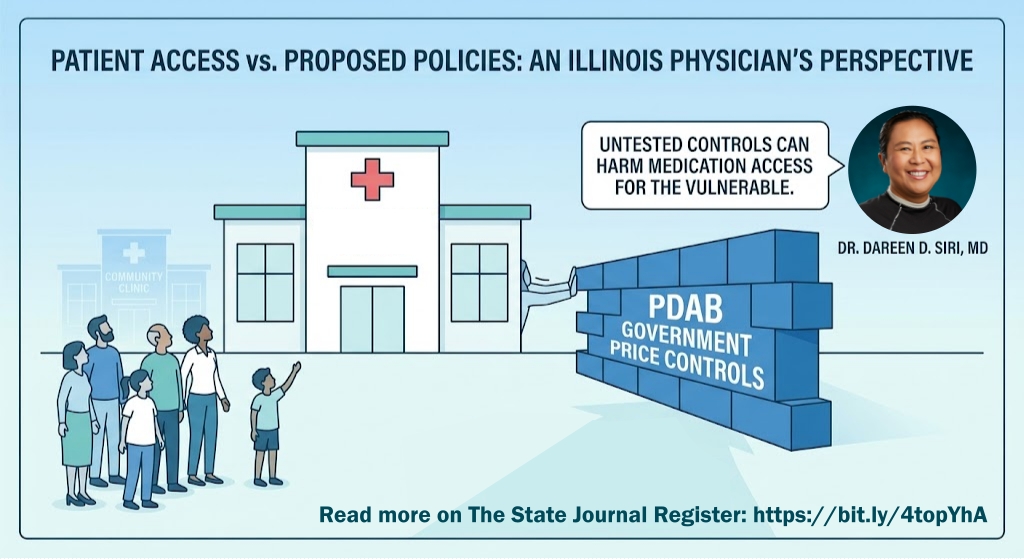
In a recent op-ed for the Springfield State Journal-Register “A drug affordability board would hurt Illinois patients”, Dr. Dareen D. Siri shares a critical perspective on the proposed Prescription Drug Affordability Boards (PDABs) in Illinois. While the goal of lowering medication costs is vital, Dr. Siri warns that the current legislative approach could inadvertently jeopardize the community-based care and medication access that patients rely on most.
Key Insights
-
A Growing Crisis: Nearly 28% of Illinois residents are currently forced to ration their medications due to rising costs.
-
The Risk of Price Controls: Proposed PDABs would allow an unelected board to set an arbitrary “upper payment limits” (UPLs) for manufacturers and healthcare providers equally. This blunt, untested financial tool fails to account for the actual costs of administering life-saving specialty drugs.
-
Threat to Local Care: These limits could squeeze community-based infusion centers—the most cost-effective and safest sites of care—forcing them to either absorb financial losses or stop offering treatments altogether.
- Beneficial vs. Misguided Targeted Reforms: The 2025 Prescription Drug Affordability Act sets an example of useful targeted structural reform which addresses predatory practices, rather than setting arbitrary and misguided reimbursement limits based on an untested model and incorrect assumptions.
Dr. Siri’s Patient Advocacy for Local Access for Treatments
“Affordability solutions that are not well thought out can actually significantly harm medication access for patients who depend on them to survive.”
As a dedicated advocate for public health and patient rights, Dr. Siri highlights that true affordability should not come at the expense of accessibility. She stands firm in the belief that the “gold standard” of care happens when physicians can directly oversee specialized treatment for vulnerable patients in a safe environment.
Dr. Siri encourages lawmakers to focus on targeted reforms, like those addressing predatory middleman practices, rather than untested price controls that could affect supplies and access to medications or shutter local clinics.
“Supporters of the PDAB often cite Colorado, an early adopter of the model, as proof of concept. But Colorado hasn’t even implemented their first UPL, which doesn’t go into effect until 2027. We don’t know whether patients will actually pay less, if the supply of affected drugs will remain stable, or how drug manufacturers will respond. Declaring the model proven based on a rule that has not yet taken effect for a single drug is premature and unsupported by real-world evidence.”