Download Visual Handout PDF here
What are PANS and PANDAS?
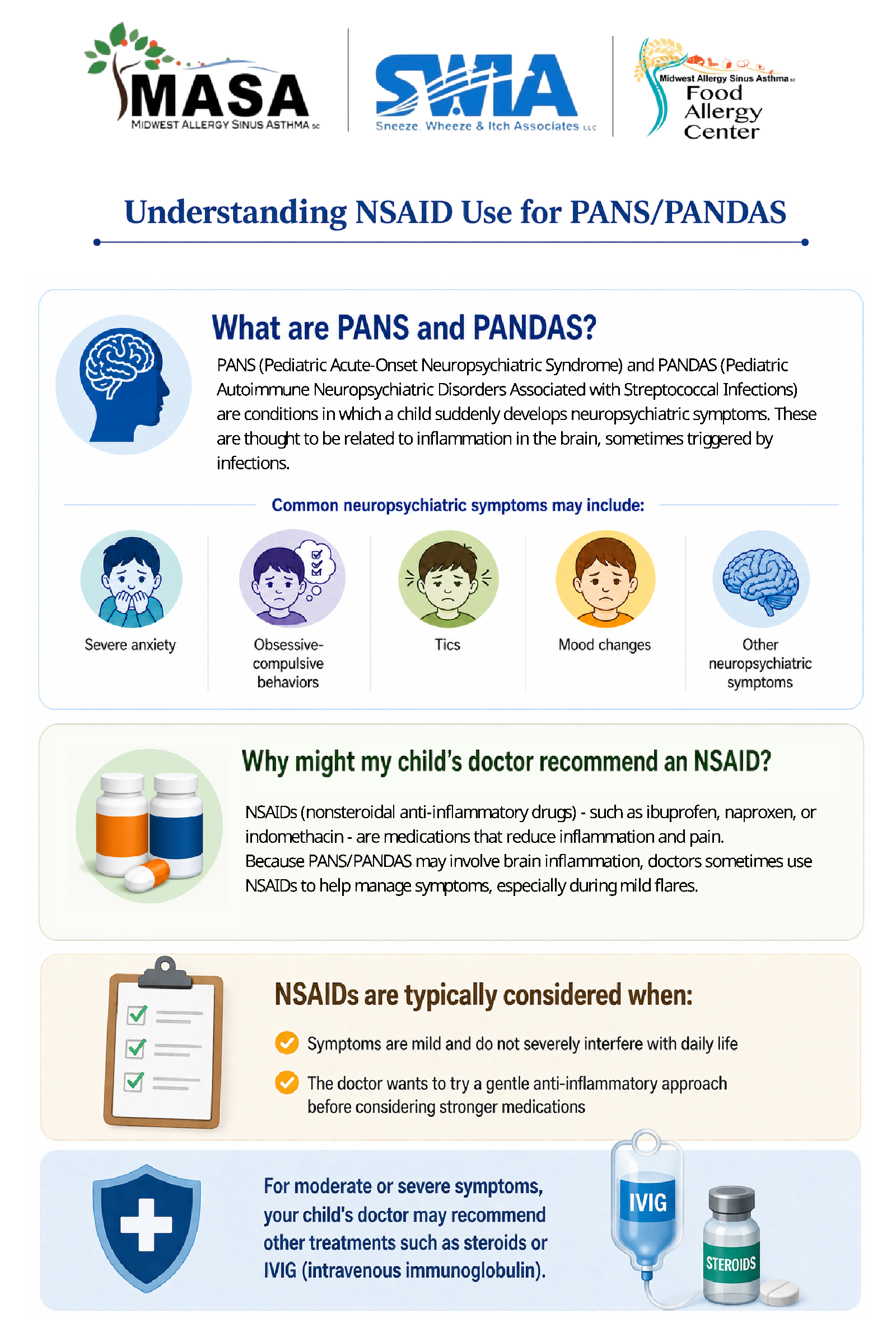
PANS (Pediatric Acute-Onset Neuropsychiatric Syndrome) and PANDAS (Pediatric Autoimmune Neuropsychiatric Disorders Associated with Streptococcal Infections) are conditions in which a child suddenly develops severe anxiety, obsessive-compulsive behaviors, tics, mood changes, or other neuropsychiatric symptoms. These symptoms are thought to be related to inflammation in the brain, sometimes triggered by infections.
Why might my child’s doctor recommend an NSAID?
NSAIDs (nonsteroidal anti-inflammatory drugs) — such as ibuprofen, naproxen, or indomethacin — are medications that reduce inflammation and pain. Because PANS/PANDAS may involve brain inflammation, doctors sometimes use NSAIDs to help manage symptoms, especially during mild flares.
NSAIDs are typically considered when:
– Symptoms are mild and do not severely interfere with daily life
– The doctor wants to try a gentle anti-inflammatory approach before considering stronger medications
For moderate or severe symptoms, your child’s doctor may recommend other treatments such as steroids or IVIG (intravenous immunoglobulin).
What does the research show?
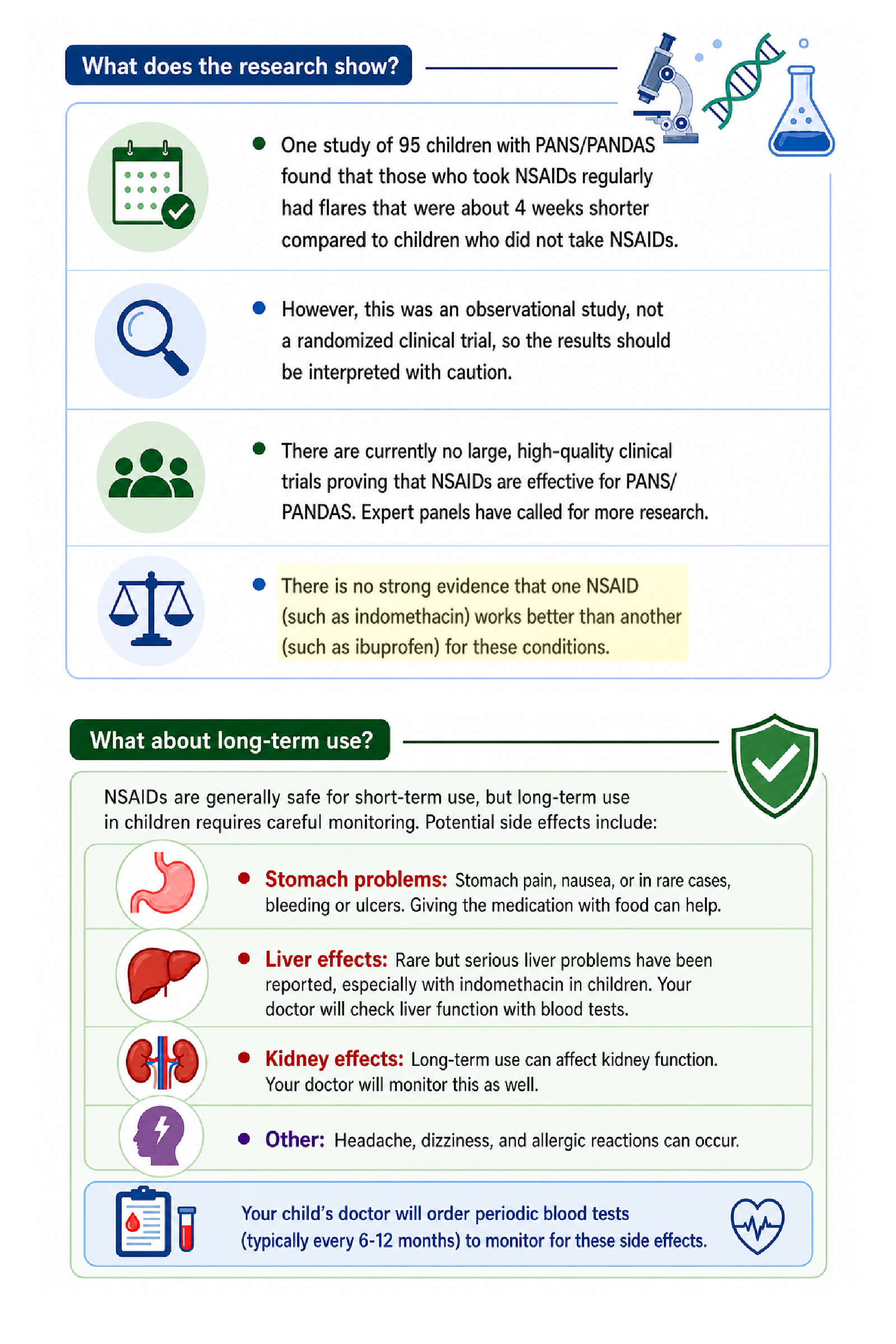
– One study of 95 children with PANS/PANDAS found that those who took NSAIDs regularly had flares that were about 4 weeks shorter compared to children who did not take NSAIDs.
– However, this was an observational study, not a randomized clinical trial, so the results should be interpreted with caution.
– There are currently no large, high-quality clinical trials proving that NSAIDs are effective for PANS/PANDAS. Expert panels have called for more research.
– There is no strong evidence that one NSAID (such as indomethacin) works better than another (such as ibuprofen) for these conditions.
What about long-term use?
NSAIDs are generally safe for short-term use, but long-term use in children requires careful monitoring. Potential side effects include:
– Stomach problems: Stomach pain, nausea, or in rare cases, bleeding or ulcers. Giving the medication with food can help.
– Liver effects: Rare but serious liver problems have been reported, especially with indomethacin in children. Your doctor will check liver function with blood tests.
– Kidney effects: Long-term use can affect kidney function. Your doctor will monitor this as well.
– Other: Headache, dizziness, and allergic reactions can occur.
Your child’s doctor will order periodic blood tests (typically every 6–12 months) to monitor for these side effects.
Important safety information about indomethacin
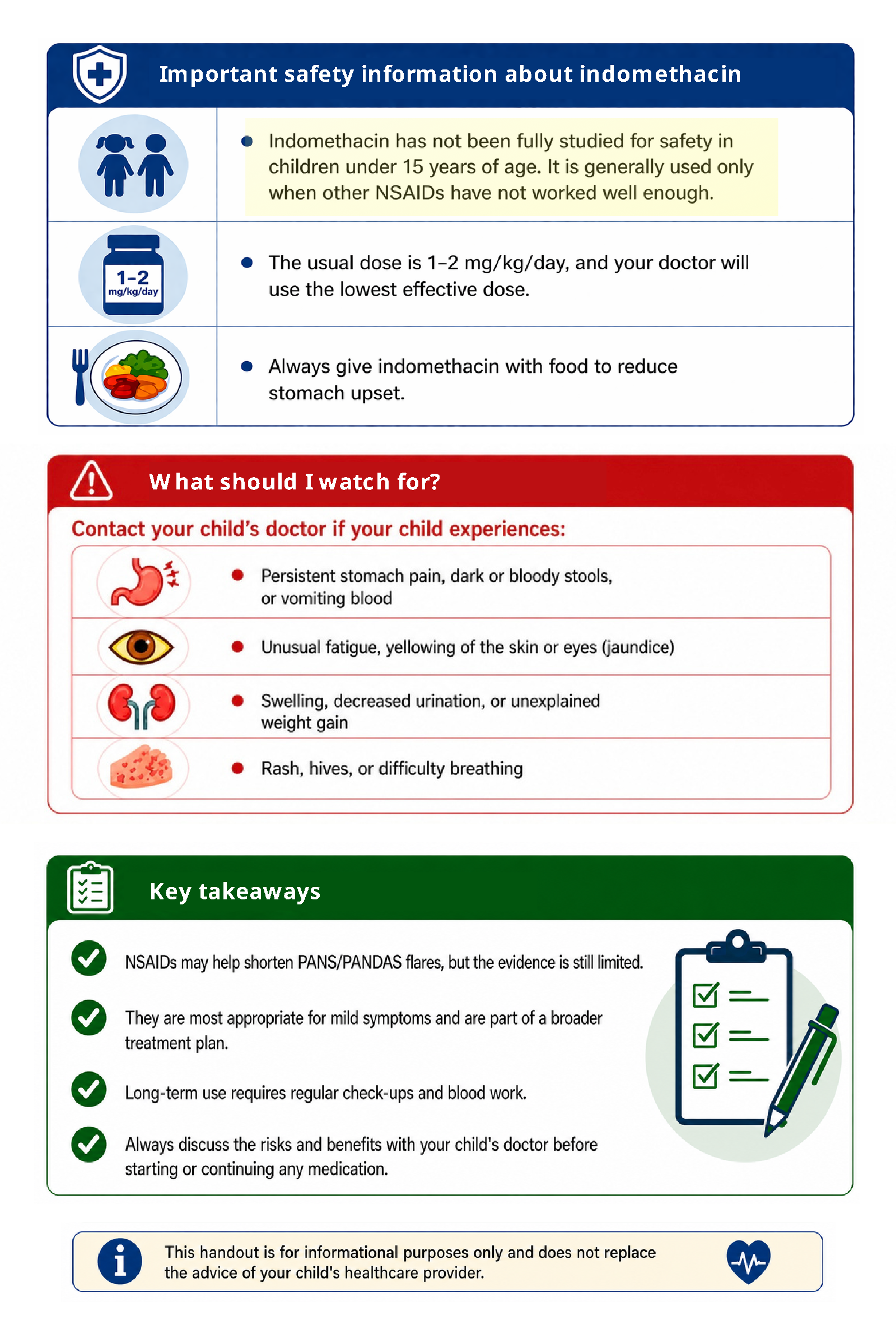
– Indomethacin has not been fully studied for safety in children under 15 years of age. It is generally used only when other NSAIDs have not worked well enough.
– The usual dose is 1–2 mg/kg/day, and your doctor will use the lowest effective dose.
– Always give indomethacin with food to reduce stomach upset.
What should I watch for?
Contact your child’s doctor if your child experiences:
– Persistent stomach pain, dark or bloody stools, or vomiting blood
– Unusual fatigue, yellowing of the skin or eyes (jaundice)
– Swelling, decreased urination, or unexplained weight gain
– Rash, hives, or difficulty breathing
Key takeaways
– NSAIDs may help shorten PANS/PANDAS flares, but the evidence is still limited.
– They are most appropriate for mild symptoms and are part of a broader treatment plan.
– Long-term use requires regular check-ups and blood work.
– Always discuss the risks and benefits with your child’s doctor before starting or continuing any medication.
This handout is for informational purposes only and does not replace the advice of your child’s healthcare provider.
In summary, the current state of evidence: the PANS Research Consortium consensus guidelines recommend NSAIDs for mildly impairing PANS, while the 2025 AAP clinical report emphasizes the lack of well-designed trials.[1][2] The flare-duration data come from the Brown et al. 2017 observational study.[3] Safety information is drawn from the FDA label for indomethacin, which notes that safety in children ≤14 years has not been established, and from ACR monitoring recommendations for children on long-term NSAIDs.[4][5][6][7]
References
- Clinical Management of Pediatric Acute-Onset Neuropsychiatric Syndrome: Part II-Use of Immunomodulatory Therapies. Frankovich J, Swedo S, Murphy T, et al. Journal of Child and Adolescent Psychopharmacology. 2017;27(7):574-593. doi:10.1089/cap.2016.0148.
- Pediatric Acute-Onset Neuropsychiatric Syndrome (PANS): Clinical Report. Pediatrics. 2025;155(3):e2024070334. doi:10.1542/peds.2024-070334.
- Effect of Early and Prophylactic Nonsteroidal Anti-Inflammatory Drugs on Flare Duration in Pediatric Acute-Onset Neuropsychiatric Syndrome: An Observational Study of Patients Followed by an Academic Community-Based Pediatric Acute-Onset Neuropsychiatric Syndrome Clinic. Brown KD, Farmer C, Freeman GM, et al. Journal of Child and Adolescent Psychopharmacology. 2017;27(7):619-628. doi:10.1089/cap.2016.0193.
- Indocin. Food and Drug Administration. Updated date: 2024-12-16.
- Indomethacin. Food and Drug Administration. Updated date: 2023-01-16.
- 2021 American College of Rheumatology Guideline for the Treatment of Juvenile Idiopathic Arthritis: Therapeutic Approaches for Oligoarthritis, Temporomandibular Joint Arthritis, and Systemic Juvenile Idiopathic Arthritis. Onel KB, Horton DB, Lovell DJ, et al. Arthritis & Rheumatology (Hoboken, N.J.). 2022;74(4):553-569. doi:10.1002/art.42037.
- 2021 American College of Rheumatology Guideline for the Treatment of Juvenile Idiopathic Arthritis: Recommendations for Nonpharmacologic Therapies, Medication Monitoring, Immunizations, and Imaging. Onel KB, Horton DB, Lovell DJ, et al. Arthritis Care & Research. 2022;74(4):505-520. doi:10.1002/acr.24839.